
 English
 Français
Jul 18, 2026
Jul 18, 2026
Jul 17, 2026
Jul 14, 2026
May 28, 2026
Mike Dooley
In many print finishing plants, the cutting section becomes the silent bottleneck nobody notices until delivery schedules start slipping. Operators may blame the guillotine cutter, the paper stock, or even the print department itself. But in reality, the issue often begins one step earlier: how paper stacks are prepared before cutting. A standalone pile turner can solve part of the problem. A complete cutting workflow solves much more. The challenge is knowing when each option makes financial and operational sense.
For medium-to-large commercial print houses, sheet-fed packaging converters, and book production facilities, stack handling directly impacts throughput. According to data published by the Printing Industries of America (PIA), inefficient material handling can account for up to 20% of lost productivity in finishing departments. That means even a fast cutter may spend too much time waiting for properly aligned paper stacks.
This is why many plants begin evaluating integrated workflows instead of isolated machines. A pile turner alone may suffice for small operations, improving aeration, dust removal, alignment, and inspection. But at higher volumes, integrated cutting lines outperform standalone equipment by reducing manual handling and ensuring stack consistency. Shops typically review high-volume workflows before comparing costs.
A pile turner is still an excellent investment under certain production conditions.
It is especially useful when:
In practice, a pile turner often improves cutting consistency because sheets become more evenly aligned before entering the cutter. This reduces skewed edges and helps minimize waste.
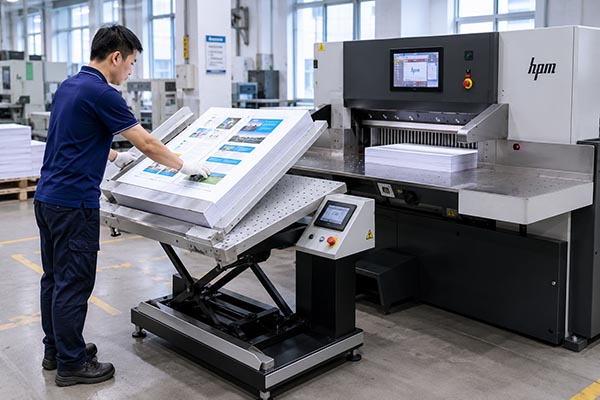
There is also an ergonomic advantage. Manual lifting of heavy paper stacks remains one of the most common causes of workplace strain injuries in finishing departments. OSHA workplace handling guidelines continue to emphasize reduced repetitive lifting in industrial environments.
But standalone pile turners also create a hidden limitation: they improve preparation, not flow continuity.
As production speed rises, these small interruptions compound quickly.
An integrated paper cutting line changes the role of the operator entirely. Instead of physically managing every stack movement, operators supervise the process while automated loaders and unloading systems maintain material flow.
This becomes especially valuable in facilities running:
The biggest improvement is not always cutting speed itself. It is the reduction of non-cutting time.
In many plants, the cutter blade may operate only 40–60% of total shift time because the rest is consumed by loading, alignment, measurement checks, and unloading. Integrated systems dramatically reduce these idle intervals.
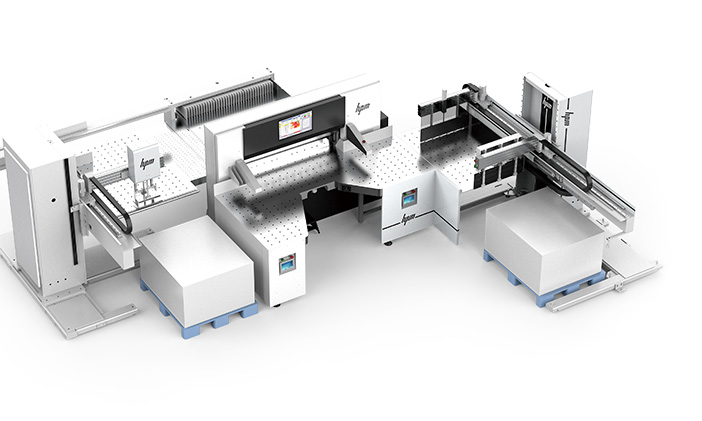
Modern workflows can also improve stack accuracy through synchronized jogging and positioning systems. This matters because poorly aligned stacks create downstream problems during folding, binding, or carton forming.
Facilities seeking to reduce manual intervention often compare automated stack handling solutions for print finishing lines alongside cutter specifications rather than evaluating the guillotine machine alone.
| Factor | Standalone Pile Turner | Integrated Cutting Workflow |
|---|---|---|
| Initial investment | Lower | Higher |
| Labor reduction | Moderate | Significant |
| Stack alignment consistency | Good | Excellent |
| Throughput improvement | Limited | High |
| Operator fatigue reduction | Partial | Major |
| Floor space efficiency | Moderate | Optimized |
| Expansion capability | Limited | Scalable |
| ROI speed in high-volume plants | Slower | Faster over time |
The decision usually depends on production scale rather than machine preference.
A smaller print shop processing short-run commercial jobs may never fully utilize a complete automated workflow. In that case, a pile turner delivers practical benefits without unnecessary complexity.
But facilities running continuous packaging or publishing work often discover that labor savings alone justify integrated handling systems within several years.
Many equipment comparisons focus only on purchase price. That is rarely the correct metric.
The more important question is: how much downtime exists between cutting cycles?
One packaging converter in Southeast Asia reportedly reduced cutting department labor by nearly 35% after replacing manual stack transfers with automated loading and unloading modules. More importantly, production scheduling became predictable because stack preparation no longer created bottlenecks during peak demand periods.
Another overlooked factor is paper damage.
Repeated manual handling increases:
These defects become expensive when processing coated stock or premium packaging materials.
This is why some converters investigate programmable cutting systems designed for continuous paper handling operations together with pile management equipment instead of upgrading individual stations separately.
If your operation handles relatively stable workloads, smaller sheet sizes, and limited shift hours, a standalone pile turner may provide enough improvement to justify the investment.
But if your team frequently experiences:
Then the issue is probably not the cutter itself. It is the workflow surrounding it.
That distinction matters.
Because once production grows beyond a certain threshold, adding isolated equipment often creates temporary relief instead of long-term efficiency.
For plants planning future automation upgrades, integrated workflows usually provide better scalability and data consistency across the finishing department.
If you want to explore more advanced options for synchronized sheet handling, automated loading, or intelligent cutting workflows, you can also review print finishing support systems used in modern paper converting lines from HPM as part of a broader production optimization strategy.
Disclaimer: Production efficiency varies depending on substrate type, operator training, maintenance conditions, and workflow configuration.
GET A QUOTE