
 English
 Français
Jul 18, 2026

Jul 18, 2026
Jul 17, 2026
Jul 14, 2026
Apr 29, 2026
Mike Dooley
In a busy print finishing department, the difference between profit and loss often comes down to one question: Can you keep running when the job size doubles?
For many plant managers, the breaking point isn’t the first 500 sheets—it’s the next 5,000. As volume climbs, so do the risks: stack shift, back gauge drift, blade wear, and operator fatigue. Addressing these issues requires more than a sharp blade. It requires rethinking how you move, clamp, and trim paper at scale.
Low-volume work is forgiving. You have time to measure, adjust, and re-cut. But high-volume jobs introduce cumulative error. Each cycle leaves micro-debris. Each clamp cycle compresses the stack differently. Over 10,000 cuts, a 0.05mm error becomes half a millimeter—enough to ruin a finished product.
According to industry guidelines on paper stack behavior (references to common finishing standards), three factors matter most when volume exceeds 5,000 sheets per run:
Clamping consistency – soft stacks compress unevenly
Back gauge rigidity – repeated impacts loosen mechanical tolerance
Waste removal – scraps trapped under the stack lift subsequent sheets
If you’ve ever seen a finished pile where the bottom sheets are longer than the top ones, you’ve witnessed this problem firsthand.
Before assuming your equipment is inadequate, run through these five checks:
1. Verify your air table function.
Debris under the pile is invisible but destructive. If your air table doesn’t float the stack evenly, side guides lose reference.
2. Review your clamp pressure curve.
Static pressure marks coated stock. A gradual pressure build—compressing then slightly relaxing—preserves both squareness and surface finish.
3. Measure back gauge squareness every 2,000 cycles.
Use a digital square. A drift of 0.1mm over 500mm length is acceptable for office paper but too high for precision packaging.
4. Log blade changes by sheet count, not calendar days.
For coated paper above 300gsm, a standard blade loses optimal sharpness after roughly 8,000–10,000 cuts.
5. Automate offloading where possible.
Manual removal introduces handling errors. An automatic delivery table keeps the remaining stack undisturbed.
There is a threshold where operational tuning reaches diminishing returns. If you run more than two shifts of high-volume work daily, or if your waste rate exceeds 3% on long runs, the bottleneck is no longer technique—it’s the machine’s duty cycle.
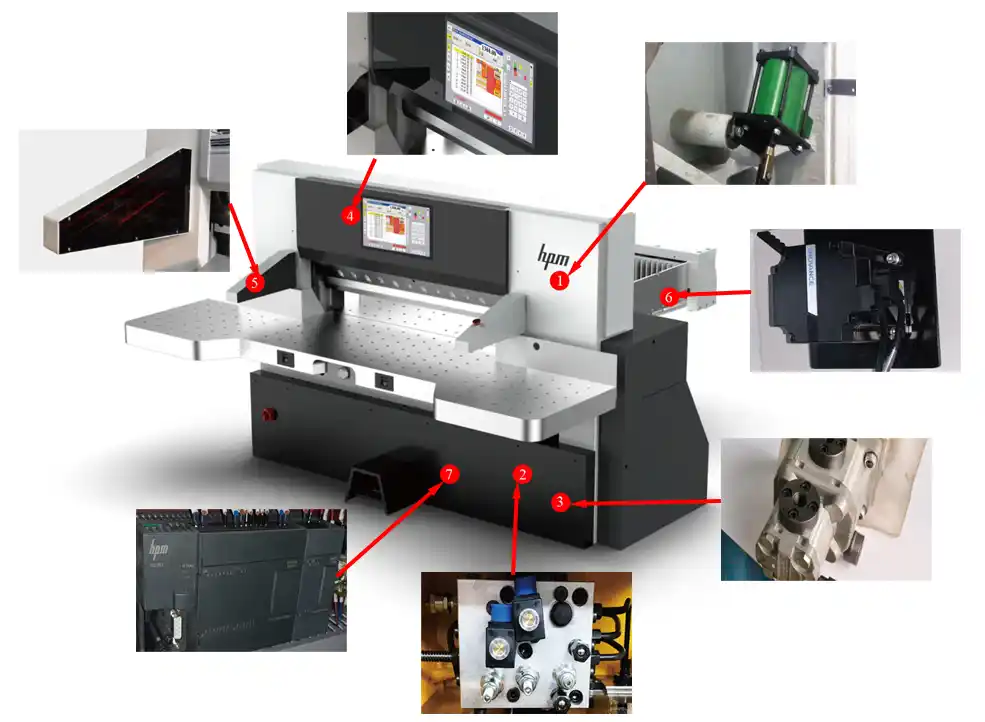
Heavy workloads demand machine frames with higher rigidity, servo-driven back gauges that resist thermal drift, and integrated scrap removal. These features are rarely found on entry-level cutters.
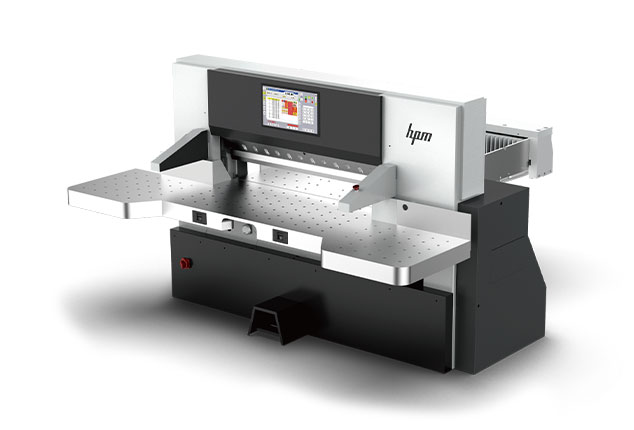
This is where a purpose-built system becomes relevant. A dedicated configuration for large runs handles everything from unstacking to final delivery. Instead of stopping to clear waste or reposition loads, the process flows continuously. The engineering focus shifts from “can it cut?” to “can it cut consistently for eight hours straight?”
If your daily workflow includes pallet after pallet of the same trim size, it may be time to evaluate dedicated heavy-volume equipment. You can review the core specifications of an industrial finishing line to understand what separates continuous-duty machines from intermittent-use models.
“Faster cycles mean higher output.”
Not if you lose squareness. Accuracy per cycle matters more than cycles per minute.
“A heavier clamp pressure fixes stack shift.”
No—excess pressure marks paper and increases knife drag. Correct pressure distribution matters more.
“All automated lines are the same.”
Differences in back gauge servo technology and frame casting quality create large reliability gaps after 6 months of heavy use.
According to feedback from packaging plants running 20+ million cuts annually, the most expensive cutter is the one that requires recalibration every week.
Selecting equipment for high-volume work is not about buying the largest machine. It’s about matching the machine’s duty cycle to your actual job mix.
Ask potential suppliers three questions:
What is the maximum stack height before back gauge deflection exceeds 0.1mm?
Is the clamping system fully programmable by stock type?
How is waste extracted without stopping the cycle?
The answers reveal whether a system is built for occasional heavy jobs or continuous high-volume production.
For finishing departments where volume is growing year over year, investing in a robust system prevents the hidden costs of rework, missed deadlines, and operator frustration. You can explore how an automated trimming solution handles sustained workloads through integrated clamp control and waste management.
High-volume jobs don’t have to mean high waste. By combining proper operational discipline with equipment designed for the task, finishing houses can run faster, cleaner, and more predictably.
Start with the checklist above. Measure your current waste rate. Log your downtime. When the data tells you that technique alone isn’t enough, the next step is clear.
If your team is ready to move beyond the limitations of intermittent-duty cutting, see how a dedicated high-volume finishing system transforms productivity for plants running thousands of sheets daily.
GET A QUOTE