
 English
 Français
Jul 18, 2026
Jul 18, 2026
Jul 17, 2026
Jul 14, 2026
Apr 22, 2026
Mike Dooley
You've watched the line run hundreds of times. Jumbo roll in, neat stacks out. But if someone asked you to explain exactly how the paper cutting line works – what each station does, why tension matters before the blade even touches the web – could you walk them through it?
Most operators can't. And that's not a failure of skill. Converting lines is surprisingly complex, with five distinct stations that must synchronize within fractions of a second.
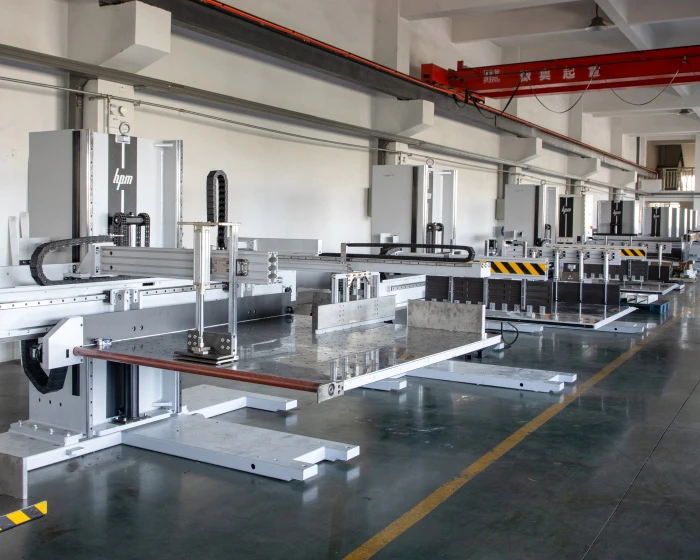
Below is a station-by-station breakdown of how a typical line converts a 1.5-meter mother roll into precision-cut sheets. No engineering degree required – just the mental model that separates "it works" from "I know why it works."
The unwind stand holds the jumbo roll and lets it spin freely – but not too freely. Its job is to release paper at a consistent rate while maintaining back tension.
Key components:
Shaft or chuck (grips the roll core)
Brake system (pneumatic, magnetic, or electric)
Roll lift mechanism (hydraulic or manual)
What happens inside: As the roll diameter shrinks, the brake must reduce holding force – otherwise tension spikes and the web stretches. Older lines require manual brake adjustment every 15–20 minutes. Modern systems use automatic tension control based on real-time diameter calculation.
Common beginner mistake: Setting the brake pressure once and forgetting it. As the roll unwinds, tension creeps up, causing edge cracks or misregistration at the cutting cylinder.
Between the unwind and the first nip roll, the paper web is essentially flying. No support above or below. If tension varies here, the web flutters – and flutter means wandering cuts.
Two main control methods:
| Method | How It Works | Best For |
|---|---|---|
| Load cell feedback | Measures actual web tension via a roller mounted on force sensors | High-speed lines, thin papers (<80 gsm) |
| Dancer roller | Weighted roller that moves up/down to absorb tension spikes | Thicker stocks, lower-speed lines |
The number to remember: ISO 12625‑7 states tension variation should stay within ±5% of setpoint for quality cuts. Many basic lines operate at ±15–20% without the operator realizing it.
For a deeper look at how closed-loop tension control differs from open-loop systems – and why it matters for your waste percentage – review HPM's tension control implementation guide.
Now the wide web enters the slitting station. Here, circular blades cut the paper into narrower rolls before final cross-cutting. Two common configurations:
A typical slitting section contains 5–20 blade pairs, each position adjustable. On manual lines, moving each pair takes 2–3 minutes. On servo-positioned systems, the entire setup changes in under 30 seconds.
This is where the continuous web becomes individual sheets. A rotating cylinder with one or two blades cuts against a stationary anvil (or another cylinder).
Key parameters:
Cut length (controlled by cylinder speed relative to web speed)
Synchronization (blade must hit exactly as the web reaches the correct position)
Cut angle (squareness to web edge)
How cut length adjustment works: To make longer sheets, the cutting cylinder slows slightly relative to web speed. Making shorter sheets speeds it up. This seems simple, but acceleration/deceleration must be perfectly timed – otherwise you get "wavy cuts" (one side longer than the other).
Industry benchmark: A well-tuned line holds cut length tolerance within ±0.5 mm across 10,000 sheets. Poor synchronization produces variation of ±3–5 mm, visible as a "staircase" stack edge.
The last station is often the most underestimated. After cutting, sheets fly onto a moving conveyor, then into a stack. The layboy's job: decelerate each sheet without folding, creasing, or misaligning.
Two layboy types:
| Type | Mechanism | Best For |
|---|---|---|
| Overlap (stream) delivery | Sheets overlap slightly, slowed by brushes or air jets | High-speed lines (200+ cuts/min) |
| Stop-and-drop (pile) delivery | Sheets stop completely before dropping | Thick boards, precise counting |
Common failure mode: Static electricity. As sheets slide and separate, static builds up. Without neutralization, sheets repel each other, causing misaligned stacks and jams at the delivery belt. Antistatic bars or ionizing blowers solve this, but many budget lines omit them.
For plants running coated or plastic-coated papers, static management becomes critical. Explore HPM's integrated static control and layboy design options if your current stack quality varies with humidity or material changes.
Each station has its own drive and sensors. But without a central control system that coordinates them, you get the "accordion effect" – a tension wave that starts at the unwind, amplifies at the slitter, and causes cut length errors at the cylinder.
Minimum control requirements for a usable line:
Speed reference shared across all driven nips
Tension setpoint that adjusts automatically for roll diameter
Cut length compensation (anticipates blade wear and web slip)
Stop-and-go coordination during roll changes
Low-end lines use open-loop drives (each motor runs independently). Mid-range and high-end lines use closed-loop positioning with encoder feedback. The difference shows up immediately during acceleration and deceleration.
Unwind the stand releases paper from the jumbo roll
Tension control stabilizes the web before it "flies."
Slitting section cuts into narrower strips
Cutting cylinder chops strips into sheets
Layboy slows and stacks sheets
Between each station, nip rollers (pinch rolls) pull the web forward without slipping. The entire system – from brake to layboy – must stay synchronized within milliseconds.
If one station drifts, every downstream station inherits the error.
Based on field feedback from 40+ converting plants, here's what separates reliable lines from daily headaches:
| Frustrating Line | Reliable Line |
|---|---|
| Manual brake adjustment every roll | Automatic tension control with load cells |
| Knife reposition takes 2 hours | Quick-change cassette or servo positioning |
| Cut length drifts after 30 minutes | Closed-loop encoder feedback |
| Static shocks operators | Active antistatic system |
| Layboy jams on coated stock | Adjustable air jet timing |
You don't need every bell and whistle. But if your line struggles with two or more items in the left column, you're losing more money to downtime than a mid-tier upgrade would cost.
For a practical checklist to audit your existing line or evaluate a new one, see HPM's line configuration comparison sheet – it ranks each station's features by impact on daily throughput.
A paper cutting line is not magic. It's five stations working in precise harmony: unwind → tension → slitting → cutting → layboy. Most problems trace back to one station drifting out of sync or a missing feedback loop.
Understanding the basics helps you:
Diagnose which station is causing waste
Communicate clearly with maintenance and vendors
Decide where an upgrade gives the best ROI
And if you're currently reading quotes and struggling to compare "apples to apples" across different suppliers, download HPM's technical glossary and specification template – it covers every term mentioned above with real-world tolerance values.
*References: ISO 12625‑7 (Paper and board – tension measurement and variation limits); TAPPI Press, "Slitting and Shearing: A Practical Guide" (2nd edition, 2019); field data compiled from 40+ plant audits conducted between 2020–2024 (available as anonymized summary upon request).*
GET A QUOTE