
 English
 Français
Article Overview: Whether you call it a paper cutter, paper guillotine, or simply a paper cutting machine, the terminology can be a significant hurdle for procurement professionals. This guide clarifies what is the name of paper cutting machine, maps different terms to machine capabilities, and provides a practical framework for evaluating industrial paper cutting solutions. You will learn what to ask before issuing an RFQ, how to align machine names with your production floor reality, and where to find reliable equipment—such as industrial paper cutting machines designed for A3/A4 digital print finishing—that fit your scaling requirements.
What Is the Name of Paper Cutting Machine? Understanding the Terminology
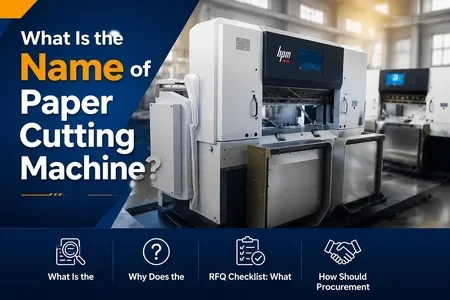
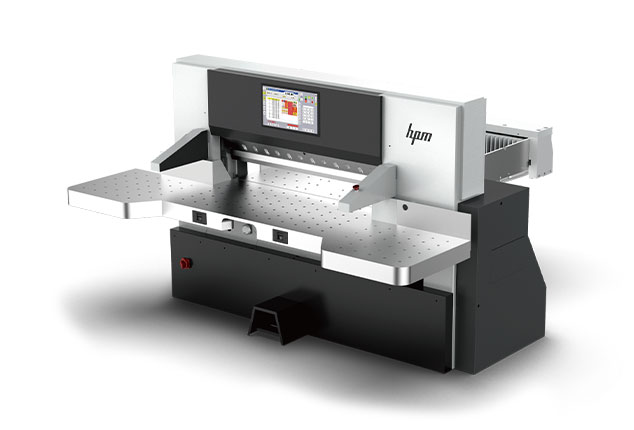
The simplest answer to “what is the name of paper cutting machine” is that it depends on who you ask, what they use it for, and where they are in the supply chain. In a commercial print shop, the operator may refer to it as a guillotine or a paper trimmer. In a packaging converter, you will hear “sheet cutter” or “reel-to-sheet cutting line.” In an office environment, a small tabletop device is a paper trimmer, while a heavy-duty industrial model is a program-controlled paper cutting machine.
For procurement managers writing an RFQ, this variety in naming creates risk. A spec sheet that asks for a “guillotine” without defining cutting width, clamp pressure, or programmability could easily receive a quote for a manual office trimmer instead of a high-speed paper cutting machine. Understanding the taxonomy is the first step to effective sourcing.
Below are the most common names you will encounter and the industrial contexts they map to:
- Paper cutting machine: The broadest industry term, used across print, packaging, and paper converting. Typically implies motorised, floor-standing equipment capable of cutting reams of paper in a single cycle.
- Paper cutter: Often used interchangeably with paper cutting machine, though in some regions it leans toward smaller, semi-automatic models.
- Guillotine: Originally a manual lever cutter, but in industrial procurement, many fully automatic program-controlled cutters are still referred to as guillotines—especially in Europe.
- Paper trimmer: Usually a light-duty device for photo labs, offices, or small digital print shops. Not suitable for bulk trimming of printed sheets.
- Sheet cutter / Reel-to-sheet cutter: Used when a roll of paper is unwound and cut into sheets inline. These are highly automated and often integrated into a complete cutting line.
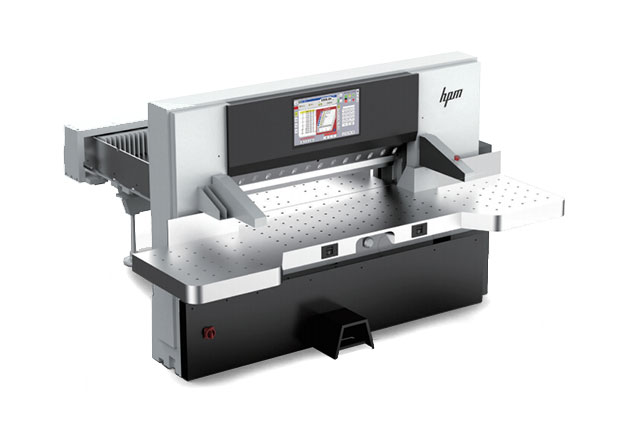
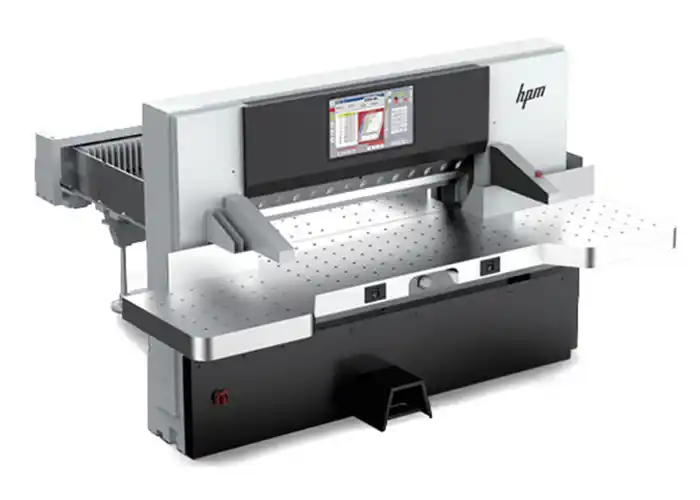
- Program-controlled paper cutter: A precision high-speed cutter with a touchscreen interface that stores cutting programs, backgauge positioning, and safety light curtains. This is the language of modern digital finishing.
When you hear a supplier use any of these terms, your immediate next question should be about the technical specifications, not the label. The name is a starting point; the data sheet is where the real conversation begins.
Why Does the Name of a Paper Cutting Machine Matter in Procurement?
Procurement in printing and packaging is a high-stakes game of specification management. A mismatch between the name used in a purchase requisition and the equipment delivered can lead to hours of rework, production delays, or capital loss. Here are three ways that unclear machine names directly impact your bottom line:
- Incorrect throughput estimation: If your team assumes a “paper cutting machine” can handle a 165 cm cutting width but only a smaller “paper trimmer” is quoted, your daily output could drop by half. Always confirm maximum cutting width, clamp pressure, and cycle speed before comparing quotes.
- Safety and compliance gaps: Industrial paper cutters require CE certification, two-hand operation, and infrared safety barriers. A domestic “paper cutter” often lacks these. Asking the right name question early filters out non-compliant options.
- Total cost of ownership blind spots: A “program-controlled paper cutting machine” implies a higher upfront investment but significantly lower labour cost. A “manual guillotine” hides operator fatigue, maintenance, and waste. Naming clarity equips you to calculate lifetime cost, not just price.
To avoid these pitfalls, standardise your internal requisition language. Instead of relying on a single name, require the supplier to fill in a structured datasheet that captures the machine’s technical identity.
What Is the Name of Paper Cutting Machine for Your Production Floor?
Not every production floor needs the same class of equipment. A digital print-on-demand shop and a high-volume packaging converter will both have “paper cutting machines,” but their specifications diverge widely. Matching the name to the job is a step-by-step evaluation process.
Step 1: Define Your Cutting Workload
Start by measuring the maximum paper size you handle, the number of lifts (reams) per shift, and the required cutting precision. A busy commercial printer may run 300 lifts per shift; an office print room might do 20. Quantify your demand in lifts per day, sheet size, and tolerance (e.g., ±0.1 mm). This data becomes the anchor for all subsequent comparisons.
Step 2: Map Terminology to Performance Classes
Use the names as a shortcut to filter suppliers. If your workload demands program control and a 145 cm width, you are in the “program-controlled paper cutting machine” or “fully automatic guillotine” class. If you mostly trim A3 prints, an “A3 paper cutting machine” or “entry-level professional paper cutter” is the right starting point. Request demos or cut samples only after you have narrowed by performance class.
Step 3: Validate with Real-World Usage Scenarios
Create a hypothetical production run: for instance, trimming 5,000 A4 brochures from SRA3 sheets to finished size in an 8-hour shift. Ask each supplier how their named machine would achieve that target. Compare not only cycle time but also setup time, blade life, and operator skill required. This exercise reveals whether the “paper cutting machine” you are being offered matches the operational reality of your print floor.
By following these steps, you move from a vague name to a performance-verified specification—a critical transition before any purchase decision.
RFQ Checklist: What Is the Name of Paper Cutting Machine and Why Precision Matters
When you prepare an RFQ, the phrase “what is the name of paper cutting machine” can serve as a reminder to be precise. A typical RFQ mistake is to title it “Paper Cutting Machine” and leave the rest open-ended. This invites a flood of irrelevant quotes. Instead, build a structured RFQ that forces precise responses.
Before you send the RFQ, verify these technical parameters. If a supplier cannot answer them clearly, their machine name may be hiding capability gaps:
- Maximum cutting width and pile height: State your paper sheet dimensions and the tallest pile you need to cut in one stroke. A 165 cm cutter with a 16.5 cm pile height handles a very different job than a 92 cm cutter with an 8 cm pile.
- Clamp pressure and drive system: Double hydraulic or single? Adjustable pressure? This determines whether the machine can hold coated stock without marking.
- Backgauge accuracy and program storage: How many cutting steps can the memory store? Can it interface with upstream JDF workflows? This matters for any shop running more than five different jobs a day.
- Safety certifications: List the required safety standards (CE, UL, ISO 13849). If the supplier cannot provide certificates, eliminate the bid.
- Blade type and change time: Hardened steel or carbide? How long does it take to swap and sharpen? This affects downtime and operating cost.
- Integration readiness: Can the cutter communicate with your paper loader, unloader, or pile turner? If you plan to scale to a full cutting line, specify the interface requirements now.
Step 1: Draft a Structured RFQ Template
Create a table that maps each performance parameter to a mandatory answer field. Do not accept “standard” or “see brochure” as answers. This step alone filters out resellers who do not understand the equipment.
Step 2: Request Production Data, Not Just Spec Sheets
Ask for documented performance from at least two installations with similar paper stocks and volumes. A “high-speed paper cutting machine” claim means nothing without real shift logs. Evaluate the data against your own production targets.
By anchoring your RFQ in verifiable specs rather than a loose name, you reduce the risk of mis-purchase and build a defensible shortlist. An industrial paper cutting machine with clear specification for A3/A4 focus, program control, and safety features, for example, makes it easier for procurement teams to gauge fit without ambiguity.
How Should Procurement Teams Evaluate Paper Cutting Machine Suppliers?
Even after you have honed your RFQ to a precise set of technical requirements, the supplier behind the machine matters just as much. For industrial paper cutting equipment, look beyond the brochure and verify these five aspects:
- Manufacturing depth: Does the supplier design and build the core cutting system in-house, or do they assemble from third-party components? Check for their own production capacity and quality control processes. A supplier that can show you their machining floor and testing bay is more likely to support the equipment long-term.
- Application expertise: Ask for case studies or references in your specific segment—commercial print, label converting, folding carton, or corrugated. A paper cutting machine that works perfectly for offset-printed book covers may struggle with thick cardboard or synthetic materials unless the supplier understands the material science.
- After-sales service and parts availability: Confirm the location of service engineers, typical response time, and whether critical spare parts are stocked regionally. A 48-hour blade delivery promise is meaningless if there is no local technician to install it correctly.
- Scalability support: If you plan to integrate a paper loader, unloader, or pile turner later, ensure the supplier can deliver a complete paper cutting machine line instead of a standalone cutter. Single-supplier integration reduces the risk of interface bugs and finger-pointing.
- Documentation and training: A thorough machine manual, maintenance schedule, and operator training program are not optional. Validate that these are included in the purchase price and are available in the language your staff reads. A cheaper quote that skips training often costs more in the first year of operation.
Vetting suppliers with this checklist transforms the name game into a procurement process built on evidence. It ensures that what you call a paper cutting machine is backed by a partner who can deliver.
FAQ
What is the most accurate name for an industrial paper cutting machine?
The most accurate term depends on the machine’s function, but “program-controlled paper cutting machine” or “industrial paper cutting machine” are widely recognized for high-volume, precision applications. For smaller professional setups, “paper cutter” or “guillotine” may apply. Always verify by specification, not by name alone.
Why do some people call it a guillotine and others a paper cutting machine?
Regional conventions and industry history play a big role. In many European print shops, “guillotine” is the traditional term for any floor-standing paper cutter, even fully automatic models. In North America and Asia, “paper cutting machine” is more common in industrial catalogues. Procurement should use both in RFQ keyword searches to avoid missing relevant suppliers.
How can I avoid buying the wrong type of paper cutting machine based on its name?
Insist on a structured datasheet that requires the supplier to fill in cutting width, pile height, clamp system, control type, and safety certifications. Then pilot the machine with your own paper stocks before issuing the full purchase order. The name of the machine is only a headline; the datasheet is your contract.
What is the name of paper cutting machine used for A3 and A4 digital print finishing?
For A3/A4 work, the equipment is often called an “A3 paper cutting machine,” “entry-level professional paper cutter,” or “small-format program-controlled cutter.” Machines like those designed for A3/A4 workflows, such as the paper cutting machine for A3/A4 finishing, exemplify this category, designed specifically for digital print shops handling standard sheet sizes with program memory and safety light curtains.
Is there a difference between a paper cutting machine and a paper trimmer?
Yes. A paper trimmer is typically a light-duty manual device for trimming photos or small stacks. A paper cutting machine is an industrial-grade piece of equipment capable of cutting through hundreds of sheets at once with powered operation and high precision.
Conclusion
The question “what is the name of paper cutting machine” opens a door that leads to dozens of terms, each carrying its own set of assumptions. For procurement managers and sourcing teams, the name is far less important than the technical reality behind it. By moving from loose naming to structured evaluation—quantifying your workload, mapping performance classes, and sending a specification-driven RFQ—you eliminate ambiguity and protect your capital.
Whether you end up calling it a program-controlled cutter, an industrial guillotine, or simply a paper cutting machine, the machine you buy must meet your production demands, safety standards, and growth trajectory. With a systematic approach and thorough supplier verification, you will select a paper cutting solution that serves your factory for years, not just a machine that matches a name.