
 English
 Français
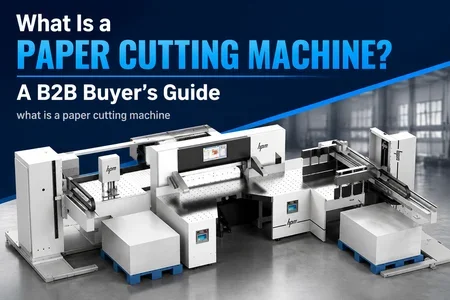
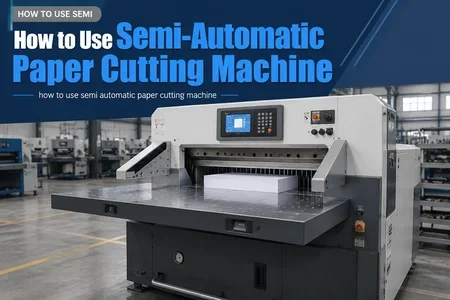
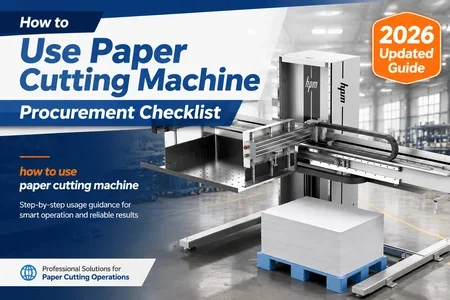
Article Overview: This guide answers a core procurement question: what is a paper cutting machine and how can you select the right industrial cutting solutions for your operation? We examine machine functions, critical evaluation criteria, RFQ development, and supplier qualification to help you make an informed purchase decision with reduced risk.
What Is a Paper Cutting Machine, and Why Does It Matter?
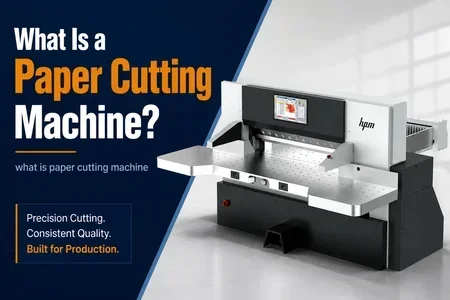
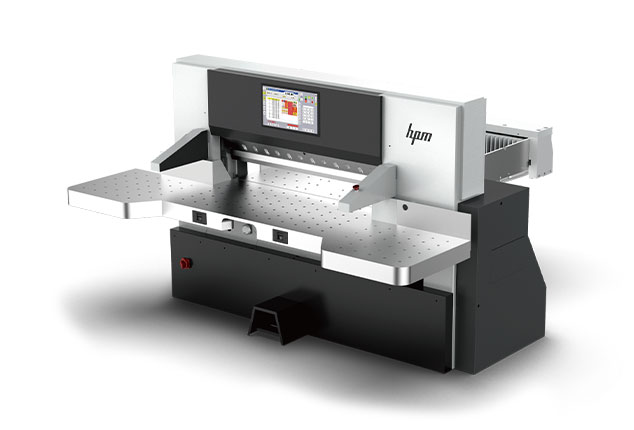
A paper cutting machine is industrial equipment engineered to cut large stacks, rolls, or sheets of paper into precise, finished dimensions. It is the backbone of print finishing, packaging converting, and paper product manufacturing lines. The answer to “what is a paper cutting machine” can range from a simple manual guillotine that trims small stacks to a fully automated cutting line that integrates feeding, cutting, and stacking at speeds exceeding thousands of sheets per hour. For procurement managers and production engineers, understanding the core machine types and their operational footprint directly influences throughput, waste, and long-term production cost.
Industrial paper cutters fall into several categories:
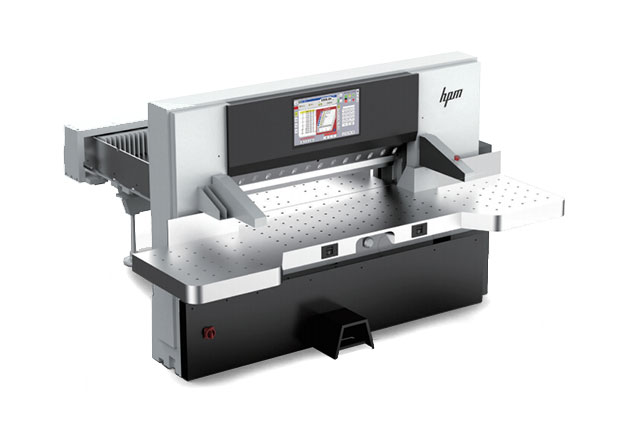
- Guillotine paper cutters: Heavy-duty machines with a single blade that shears through a clamped paper stack. They are the workhorses of commercial printing and packaging, offering high accuracy and variable cut heights.
- Rotary cutters: Continuous slitting or sheeting machines that use rotating knives to process paper webs at high speed, ideal for label stock, flexible packaging, and paper converting lines.
- Digital die cutters: Computer-controlled cutting tables that use drag knives, oscillating tools, or lasers to create complex shapes without a physical die. These suit short runs and prototyping but are less common in high-volume packaging.
- Programmable cutters: Semi‑automatic guillotines with digital backgauge control, allowing stored job settings and improved repeatability for medium-duty shops.
For buyers at packaging converters or print plants, the selection is not about the device alone—it is about the production system around it. A cutting line that includes a loader and an automatic stacker can eliminate manual handling bottlenecks, reduce worker fatigue, and raise net output by 30–50% compared to a standalone cutter. Before writing an RFQ, teams must map the machine’s role against their daily cut volume, sheet size range, and required tolerance band.
How Do Industrial Paper Cutting Machines Cut, Stack, and Output?
Understanding the physical workflow inside a modern paper cutting machine is essential for evaluating whether a machine meets your plant’s material flow. The following breakdown mirrors the steps a procurement engineer should verify on a supplier’s line visit.
Step 1: Paper Loading and Feeding
The process begins with the loading mechanism. In sheet-fed machines, an operator places a paper stack on the rear table, and a mechanical or air-cushion table simplifies alignment. Roll-to-sheet lines use an unwind stand with tension control to feed the web into a decurler before it reaches the knife. Automated loaders reduce physical strain and improve cycle time by staging the next lift while the current pile is being cut.
Step 2: Alignment and Clamping
Once the stack is in position, a motorized backgauge moves the paper to the programmed cut line. Optical sensors or camera alignment systems on high-end machines can detect printed registration marks for precision cutting. A hydraulic or pneumatic clamp then presses the stack firmly to prevent sheet movement during the knife stroke. Clamp pressure must be adjustable; too little pressure causes mis-cut, and too much can mark sensitive coated stocks.
Step 3: Knife Actuation and Cutting
The cutting cycle is triggered automatically after clamping. In a guillotine, a heavy knife beam, driven by a hydraulic cylinder or a crank mechanism, descends at a controlled angle to shear through the stack. Knife material (usually high-speed steel or carbide-tipped) and bevel angle directly affect blade life and cut quality. Rotary cutters use a pair of helically ground drums that create a scissor-like action, capable of slit widths as narrow as 15 mm on paper webs running at 200 m/min.
Step 4: Stacking and Discharge
After the cut, the finished sheets or labels must exit the machine without jamming or edge damage. Guillotine cutters use a front discharge belt or a jogger table that aligns the output ream. In fully automated lines, an unloader or a robotic palletizer picks up the cut stack and places it onto a conveyor or directly onto a pallet. Integrated lines often include a waste removal system to separate trim strips from the good product, keeping the area clean and reducing manual sorting.
When evaluating a machine, procurement teams should request a video of the full cycle—from loading to pallet—to confirm that the supplier’s automation design matches the actual material behavior in the plant.
What Should You Evaluate Before Requesting a Quotation?
Before you send an RFQ to a manufacturer, your team should compile a checklist of technical and commercial requirements. This step prevents overlooking hidden costs and ensures that supplier responses are comparable. Use the following ordered criteria to structure your evaluation:
- Cut accuracy and repeatability. Ask for the positional tolerance at maximum cut height and speed. For four‑up label cutting, ±0.1 mm is often the minimum required. Obtain evidence from test-cut reports.
- Maximum cut height, width, and sheet length. A guillotine’s cut height typically ranges from 120 mm to 210 mm or more. Confirm the machine can accommodate your largest sheet dimensions plus some headroom for special jobs.
- Automation level and integration. Decide whether you need a standalone cutter or a complete cutting line with loading, stacking, and possibly a pile turner. An automatic line reduces labor dependency but demands higher initial capital.
- Safety and compliance. Verify that the machine carries CE marking (for Europe) or equivalent local certifications. Front photoelectric barriers, two-hand control, and blade brake systems are non‑negotiable for operator protection.
- Knife change and maintenance accessibility. A tool‑less knife change system can cut downtime from 30 minutes to under 5 minutes per shift. Check lubricant points and whether remote diagnostics are supported.
- Energy consumption and utilities. Hydraulic machines require cooling and oil filtration; electric cutters are more energy-efficient but have different torque characteristics. Include power rating in your total cost of ownership model.
- Supplier’s production capacity and lead time. Visit the supplier’s manufacturing floor or request third-party audits. A supplier with a documented production capacity that matches your order volume will better meet delivery schedules and quality consistency targets.
By organizing these criteria into a scored decision matrix, sourcing teams can shortlist two or three qualified manufacturers and move smoothly into the negotiation phase.
What Is a Paper Cutting Machine RFQ Process?
A well-structured RFQ not only draws accurate quotations but also reveals a supplier’s technical depth. Many procurement mistakes happen because the RFQ is too vague, leaving room for suppliers to propose mismatched equipment. Follow this five-step process to draft an RFQ that drives meaningful responses.
Step 1: Define Throughput Requirements
State your target output in sheets‑per‑hour or tons‑per‑shift, accounting for planned growth over the next three years. A supplier will use this number to recommend the right machine speed, buffer conveyors, and stacking frequency.
Step 2: Specify Material Parameters
List the paper grades (coated, kraft, board, label) and grammage ranges your plant runs. Also include details on moisture content and static behavior, which influence feeding and knife wear. If you process pressure‑sensitive or silicone‑coated substrates, request information on anti‑stick coating compatibility.
Step 3: Outline Automation Integration
Describe your existing upstream and downstream equipment: sheeter, printing press, conveyor, wrapping machine. Ask each bidder to propose a control interface (Ethernet/IP, Profinet, or OPC UA) and to confirm whether their machine can exchange job data with your MIS/ERP system.
Step 4: Request Lifecycle Cost Data
Beyond the purchase price, ask for spare‑parts list, recommended inventory value, average knife life per ton, and estimated power consumption at typical load. A reputable supplier will provide a TCO (total cost of ownership) projection covering at least five years of operation.
Step 5: Draft a Technical Compliance Checklist
Compile a table of mandatory and optional features (safety sensors, zero‑stack error detection, air table, backgauge programmability, etc.) and ask each bidder to mark “yes,” “no,” or “optional.” This checklist becomes a quick apples‑to‑apples comparison tool.
When detailing your requirements, refer to comprehensive paper cutting machine solutions that match your production scale. A supplier that can demonstrate similar installations with case‑study data is far more credible than one offering only a catalog.
FAQ
What is the typical cost of an industrial paper cutting machine?
Prices vary widely by automation level and cut size. A basic semiautomatic guillotine may start in the $15,000–$30,000 range, while a fully automated cutting line with loaders and stackers can exceed $150,000. Buyers should request a detailed quotation that separates equipment, installation, and training costs.
How do I choose between a manual and automatic paper cutting machine?
The decision hinges on daily volume and labor cost. If your shop cuts fewer than 500 sheets per shift and has a small staff, a manual or semiautomatic machine may suffice. For continuous, high‑volume operations, an automatic cutting line with program memory and automatic feeding/stripping recovers its investment through reduced labor and higher throughput.
What maintenance does an industrial paper cutting machine require?
Daily checks include knife sharpness, clamp pad condition, and sensor cleanliness. Monthly tasks involve lubricating guide rails and checking hydraulic oil levels. Annual services should cover full calibration, seal replacement, and safety system testing. Many suppliers offer remote monitoring to predict maintenance needs before breakdowns occur.
Can a paper cutting machine handle non‑paper materials?
Industrial paper cutters can often cut thin plastic films, adhesive labels, and lightweight cardboards. However, hard materials like rigid PVC or metal foils require specialized knife geometry and may void the warranty. Always confirm material compatibility with the manufacturer before processing non‑standard substrates.
Conclusion
A paper cutting machine is a capital investment that sits at the heart of your converting or print finishing line. By starting with a clear definition of what a paper cutting machine must do in your facility—not just what the catalog promises—you can avoid oversimplified selections and costly rework. Build your RFQ around measurable criteria, validate supplier production capabilities, and insist on lifecycle cost transparency. With a disciplined procurement process, your team can secure a cutting solution that meets today’s production targets and scales for tomorrow’s growth.
Related site pages: what is paper cutting machine, Home.