
 English
 Français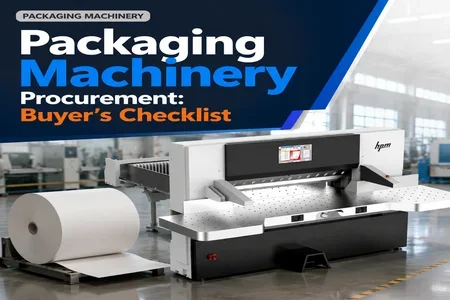
Article Overview: This guide assists procurement managers, sourcing teams, and project engineers in packaging machinery supplier evaluation and RFQ issuance. It covers critical checkpoints—from defining production requirements to validating supplier claims—using a practical checklist approach to reduce procurement mistakes. By following this systematic method, buyers can shortlist qualified suppliers, compare proposals objectively, and secure machinery that meets capacity, quality, and cost targets.
What Are Your Actual Production Requirements?
Before engaging suppliers, you must clearly define your production requirements. This includes output volume, material types, speed, footprint, and integration with existing lines. Vague requirements lead to mismatched proposals and wasted evaluation time. Start by documenting:
- Annual production volume (units or sheets per year)
- Material specifications (paper weight, size, coating, or other substrate)
- Required uptime and maintenance intervals
- Existing automation level and compatibility with new equipment
- Future scalability plans (e.g., line expansion or product diversification)
- Floor space limitations and layout constraints
Quantifying these parameters early helps filter suppliers who cannot meet your basic needs. For example, if your line requires 12,000 packs per hour, only suppliers with documented proven production capacity for high-speed lines should be shortlisted. Use a structured requirements table to communicate these consistently across all RFQs. Additionally, consider environmental factors such as temperature and humidity that may affect machine performance. Engage cross-functional teams—production, maintenance, and quality—to capture all operational constraints. A detailed requirements document will also serve as the baseline for supplier proposals, making it easier to compare bids objectively. If you foresee future product changes, note the expected range of materials and formats to select flexible machinery.
How to Evaluate Packaging Machinery Suppliers?
Supplier evaluation goes beyond price. Focus on production capacity, technical capability, and service support. A supplier’s manufacturing scale directly affects lead times, customization options, and long-term reliability. Verify the supplier’s manufacturing scale, quality control processes, and ability to handle your order volume. Key evaluation criteria include:
- Production capacity and facility audits (on-site or virtual)
- Certifications (ISO 9001, CE, UL, etc.) as seen in typical certification examples
- Reference installations and customer feedback (ask for at least three recent clients)
- After-sales support and spare parts availability (response times, local service engineers)
- Technology innovation track record (e.g., servo drives, IoT integration) – review technology innovation efforts for reference
- Financial stability and order book depth
For example, a supplier with robust manufacturing capabilities can offer shorter delivery times and more flexible customization. Consider visiting the production facility or conducting a virtual audit. Pair this with a review of their product portfolio to ensure consistency between stated capabilities and actual offerings. Also evaluate the supplier’s experience in your specific industry sector—packaging for food, pharmaceuticals, or industrial goods each have distinct regulatory and operational requirements. Request detailed case studies that demonstrate similar installation complexity. Another important factor is the ability to provide ongoing training and remote diagnostics. A well-structured after-sales program minimizes downtime and extends equipment lifespan. Finally, check the supplier’s supply chain resilience: Do they source critical components from multiple regions? Have they faced recent disruptions? This risk assessment helps avoid unexpected delays.
What Key Elements Should an RFQ Include?
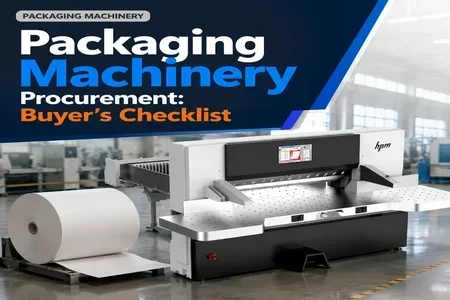
An effective RFQ reduces ambiguity and improves bid comparability. Include the following elements in your packaging machinery RFQ:
- Detailed technical specifications (speed, power, dimensions, materials)
- Material and environmental conditions (temperature, humidity, corrosiveness)
- Required certifications and standards (safety, electrical, industry-specific)
- Delivery timeline and installation support (milestones, training, commissioning)
- Service level agreements (response time, spare parts, remote diagnostics)
- Payment terms and warranty conditions (phased payments, performance bonds)
- Expected lifespan and upgrade paths
Share the RFQ with multiple qualified suppliers. Use the responses to create a comparison matrix covering price, lead time, and compliance. For integrated solutions, consider modularity; a customized solution approach may better align with future scalability. Include a clear deadline and a single point of contact for clarifications. Additionally, request suppliers to provide a lifecycle cost estimate—including energy consumption, maintenance intervals, and spare part costs. This helps assess total cost of ownership rather than just upfront price. Ensure the RFQ includes clear acceptance criteria and performance benchmarks for factory and site acceptance tests. These measures reduce the risk of disputes later. Finally, ask for a preliminary project schedule detailing design, manufacturing, shipping, installation, and ramp-up phases.
How to Validate Supplier Claims Before Purchase?
Validate claims through site visits, sample production runs, and third-party audits. Request references and contact previous buyers. Check the supplier’s product lines for consistency with stated capabilities. Review their technology innovation updates to ensure long-term relevance. Conduct a risk assessment covering financial stability, supply chain resilience, and after-sales network. For high-value investments, consider phased payments tied to milestones such as factory acceptance test (FAT), shipment, installation, and final acceptance. Also ask for a spare parts list and average lead times for critical components. To see how a well-structured service plan supports uptime, review maintenance program examples. Another critical step is requesting a demonstration of the machine running your actual materials at required speed to eliminate ambiguities in specification sheets. If a site visit is not feasible, a live video test with measurable output can provide comparable evidence. Ask suppliers to share quality control documentation, such as inspection reports and test certificates. For integrated lines, request a simulation or digital twin that shows material flow and potential bottlenecks. Engaging an independent engineering consultant can provide unbiased assessment of technical claims. Finally, include contractual provisions tying payment to performance guarantees.
Comparison: Single Machine vs. Integrated Line Procurement
| Factor | Single Machine | Integrated Line |
|---|---|---|
| Upfront cost | Typically $50k–$200k | Typically $500k–$2M |
| Installation complexity | Low to moderate | High – requires line integration expertise |
| Scalability | Easily replaceable or expandable | Modular, but changes disrupt entire line |
| Overall efficiency | Limited by manual transfers | High – automated material flow |
| Maintenance needs | Per-machine service | Integrated system monitoring |
| Supplier dependency | Multiple suppliers possible | Typically one lead integrator |
Note: Actual costs and benefits vary by configuration. Validate all numbers against your specific production scenario. When deciding between a single machine and an integrated line, consider your in-house engineering capacity. If your team is experienced in line integration, the flexibility of a modular approach may outweigh the convenience of a turnkey solution. For high-volume operations with minimal product changeovers, integrated lines often yield faster ROI. Conversely, if you anticipate frequent format changes or need to allocate capital incrementally, starting with a single machine may be more prudent. Always conduct a total cost of ownership analysis that includes training, downtime, and potential production losses during changeovers.
FAQ
How long does a typical packaging machinery procurement cycle take?
The cycle depends on complexity. For standard machines, 3–6 months; for integrated lines, 6–12 months. This includes requirement definition, RFQ, evaluation, negotiation, production, and installation. Delays often occur during specification finalization—invest time upfront. Use a standardized RFQ template and pre-qualify suppliers to expedite the process.
Should I prioritize price or production capacity when selecting a supplier?
Neither alone is sufficient. Balance cost against manufacturing scale, quality track record, and service support. A low-cost provider with insufficient capacity may cause delays and quality issues. Use a weighted scorecard that includes capacity as a key criterion.
What are the three milestones to clear before funding packaging machinery changes?
1) Validate internal production needs. 2) Benchmark at least three qualified suppliers. 3) Conduct on-site capability verification before issuing a purchase order.
Is it better to buy a single machine or an integrated line?
It depends on production scale, budget, and growth plans. Single machines offer flexibility and lower upfront cost; integrated lines improve efficiency and reduce handling. Evaluate both with a total cost of ownership analysis, including maintenance, training, and downtime costs. Explore efficiency-focused solutions for real-world examples.
How can I reduce risk when procuring machinery from overseas suppliers?
Conduct a virtual factory audit, use a third-party inspection company, and require performance bonds. Ensure the contract includes clear dispute resolution mechanisms and that all documentation is in English. Build in extra lead time for shipping and customs clearance.
Conclusion
Successful packaging machinery procurement requires a systematic approach. Start by defining your requirements, evaluate suppliers based on production capacity and technical fit, structure your RFQ clearly, and validate all claims before purchase. Use this checklist to reduce risks and make informed decisions. For further guidance on supplier evaluation criteria, review production capacity resources and other tools from industry partners. Always compare at least three qualified vendors and conduct proper due diligence to secure the best equipment for your operation.