
 English
 Français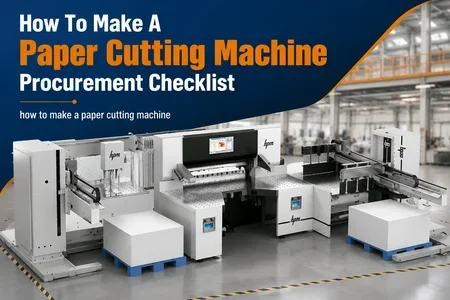
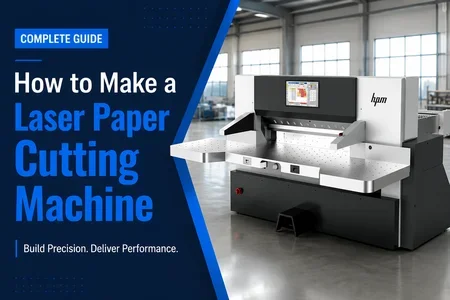
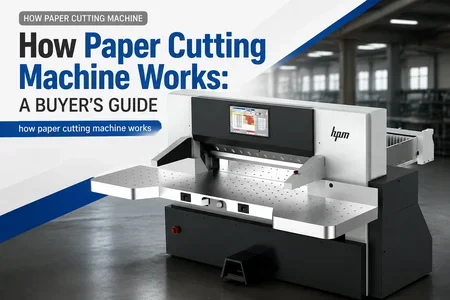
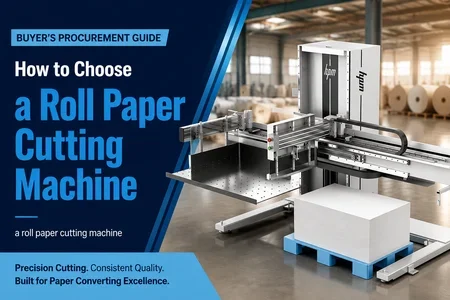
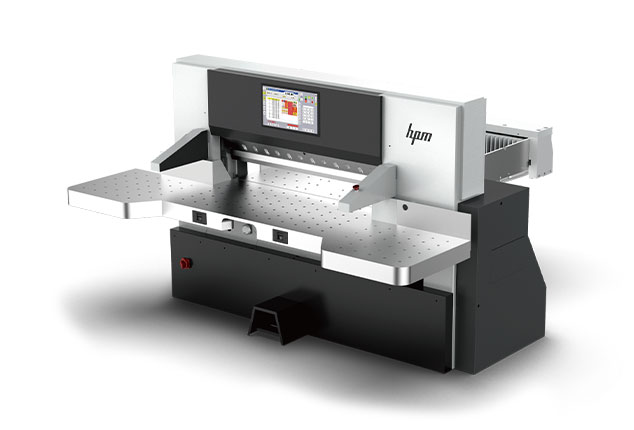
Article Overview: This guide helps procurement decision-makers understand how to make a paper cutting machine purchase that aligns with production goals. We cover essential checkpoints, supplier evaluation, cost-risk tradeoffs, and inquiry preparation—all anchored to real-world industrial scenarios. For a reliable starting point, explore paper cutting machine solutions that match typical mid-volume requirements.
Procurement Checklist for How to Make a Paper Cutting Machine
When evaluating how to make a paper cutting machine investment, buyers must move beyond basic specifications. The following flow blocks outline a systematic approach to avoid common pitfalls.
Phase 1: Define Production Requirements
- Volume and throughput: Determine sheets per minute or daily output needed. For example, a small print shop may require 3,000 sheets/hour, while a packaging plant might need 10,000+.
- Material dimensions: Specify maximum and minimum paper sizes, grammage ranges (e.g., 60–350 gsm), and whether you handle coated or uncoated stock.
- Cut quality standards: Define acceptable tolerance (e.g., ±0.5 mm) and whether you need corner rounding, perforation, or creasing.
- Operator skill level: Assess if your team can handle programmable logic controllers (PLC) or requires a more automated touchscreen interface.
Phase 2: Evaluate Machine Specifications
- Cutting technology: Compare guillotine vs. rotary vs. laser. For most industrial paper cutting, hydraulic guillotine is cost-effective for stacks; laser is precision but higher cost.
- Safety features: Look for light curtains, two-hand controls, automatic blade brake, and CE or UL certification.
- Automation level: Decide between manual feed, semi-automatic (auto clamp, manual back gauge), or fully automatic (auto load/unload).
- Maintenance accessibility: Check if blade changes require specialized tools and if the supplier provides local maintenance contracts.
Key Considerations for How to Make a Paper Cutting Machine Efficiently
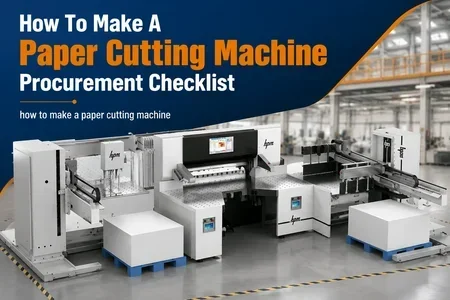
Once basic specifications are clear, efficiency and integration become the next priorities. How to make a paper cutting machine part of a smooth workflow involves:
- Inline vs. offline operation: Decide whether the cutter will be fed directly from a printing press (inline) or operate as a separate station (offline). Inline reduces handling but requires precise synchronization.
- Connectivity: Machines with Ethernet/IP or OPC-UA allow integration with your ERP system for job scheduling and real-time monitoring.
- Changeover time: Evaluate how quickly the machine can switch between paper sizes. Quick-change clamps and automated back gauge position can reduce downtime by 30–50%.
For example, a mid-size commercial printer producing business cards and brochures might opt for a semi-automatic machine with automated back gauge and no inline connection, prioritizing flexibility over full automation.
How to Compare Suppliers and Reduce Risk
Procurement risk arises from three sources: supplier reliability, hidden costs, and after-sales support. Use the following checklist to mitigate these.
Phase 3: Supplier Evaluation Criteria
- Track record: Request client references for machines similar to your application. Verify installation dates and uptime percentages.
- Certifications: ISO 9001 for quality management, CE for European compliance, and UL for North America. These reduce compliance risk.
- Spare parts availability: Confirm lead times for commonly replaced parts (blades, bearings, hydraulic seals). A supplier with a local warehouse reduces downtime.
- Training commitment: Does the supplier offer on-site training for operators and maintenance staff? Ask for detailed training curriculum.
- Warranty and service level: Compare standard warranty periods (typically 12–24 months) and response times for service calls (e.g., 48-hour dispatch).
Additionally, consider requesting a factory acceptance test (FAT) before shipment and a site acceptance test (SAT) after installation. These steps can reveal issues early and transfer accountability to the supplier.
Implementation and Cost-Risk Tradeoffs
The total cost of ownership (TCO) for a paper cutting machine goes beyond the purchase price. Evaluate these factors:
- Blade lifecycle: Quality HSS blades may cost 30% more but last 3X longer than standard steel. Calculate cost per cut.
- Energy consumption: Hydraulic pumps run continuously in older models; newer servo-driven machines consume 50% less electricity.
- Floor space and installation: Fully automated lines with conveyors require larger footprints and reinforced floors. Factor in rearrangement costs.
- Financing options: Some suppliers offer leasing or pay-per-use models. Compare net present value (NPV) over a 5-year horizon.
For instance, a packaging company producing 2 million cuts per year might find that a premium machine with lower blade wear and energy savings offers a 2-year payback despite a 25% higher initial investment.
Preparing Your Inquiry for Maximum Clarity
A well-structured request for quotation (RFQ) can save weeks of back-and-forth. Include these elements:
Phase 4: Create a Detailed Inquiry Checklist
- Target machine profile: Specify sheet size (width x length), stack height, cutting speed, and tolerance.
- Required certifications: List safety and quality standards your facility must meet.
- Accessories and options: Indicate if you need a paper loader, unloader, waste removal system, or software for job management. Refer to tailored solutions for common configurations.
- Installation conditions: Provide voltage, compressed air availability, and floor dimensions.
- Expected delivery timeline: Typical lead time is 4–12 weeks; ask for expedited options.
- Service contract details: Request annual preventive maintenance costs and operator training fees.
Send the same RFQ to at least three suppliers to enable apples-to-apples comparison. Require a detailed quote that breaks down machine price, shipping, installation, taxes, and warranty.
FAQ
What should buyers evaluate first about how to make a paper cutting machine?
Start with fit, evidence-backed requirements, and supplier proof relevant to how to make a paper cutting machine before shortlisting vendors.
How can teams reduce procurement risk for how to make a paper cutting machine?
Use structured comparison, validate specifications early, and review implementation or quality checkpoints with documented evidence.
Related articles
- How to Make a Laser Paper Cutting Machine
- How Paper Cutting Machine Works: A Buyer's Guide
- How to Choose a Roll Paper Cutting Machine
Conclusion
Mastering how to make a paper cutting machine procurement requires a disciplined approach: define requirements, evaluate specifications, compare suppliers, and plan for total cost. Use the flow-block phases above as a repeatable checklist. By focusing on fit, supplier credibility, and post-purchase support, procurement teams can significantly reduce risk and achieve reliable, high-quality output for years to come.