
 English
 Français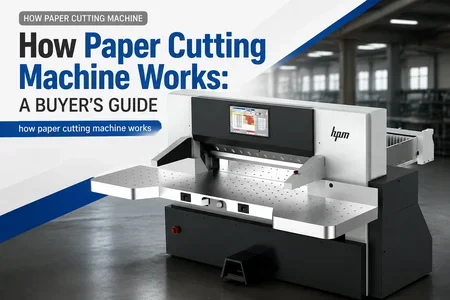
Article Overview: This guide explains how paper cutting machine works, from the basic cutting action to programmable control systems. It provides procurement managers with actionable checkpoints for evaluating suppliers, understanding key components, and avoiding common purchasing mistakes when selecting a paper cutting machine for printing or packaging operations. The article focuses on industrial guillotine-style cutters, the most common type used in commercial print shops and converting facilities.
How Paper Cutting Machine Works: The Core Mechanism
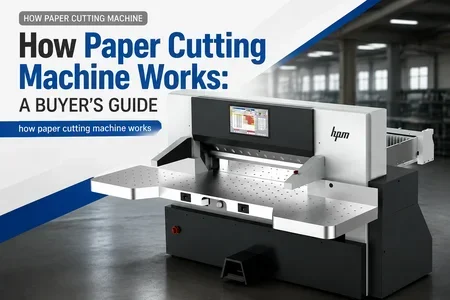
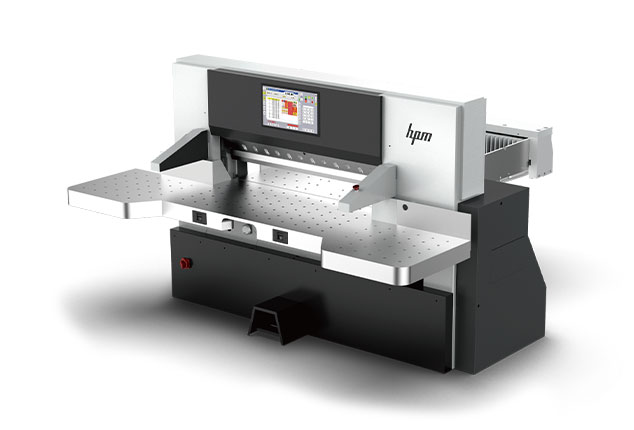
At its simplest, a paper cutting machine uses a heavy steel blade that moves vertically to cut a stack of paper. The paper is clamped firmly in place, and a back gauge positions the paper to the exact stop location. The entire cycle is controlled either manually or through a programmable logic controller (PLC) that stores up to hundreds of cut programs. Understanding how paper cutting machine works in detail helps buyers specify the right machine for their production volumes and precision requirements.
Step 1: Paper Loading and Alignment
The operator or an automatic paper loader places the pile onto the front table. The pile is aligned against the side guide and back gauge to square the sheets. This step is critical for cut accuracy; even a 0.5 mm misalignment can cause waste in subsequent processes.
Step 2: Clamping
A hydraulic or mechanical clamp descends to hold the paper stack firmly. The clamping pressure must be sufficient to prevent sheet movement during cutting, but not so high that it marks or damages the paper. Adjustable clamp pressure is a feature procurement teams should verify.
Step 3: Cutting Action
The blade, typically made of hardened alloy steel, moves downward through the paper stack. Most industrial cutters use a shearing action where the blade contacts the paper at an angle, reducing force and improving cut quality. The blade path is guided by linear rails for repeatable precision.
Step 4: Back Gauge Positioning
After the cut, the back gauge moves the paper to the next programmed position. High-end machines use ball screws and servo motors for positioning accuracy within ±0.1 mm. For procurement, check if the back gauge speed and repeatability meet your job changeover requirements.
What Key Components Determine Machine Reliability?
Beyond the basic cutting cycle, several components determine the machine’s reliability, safety, and productivity. When evaluating suppliers, pay attention to these parts:
- Blade and Blade Changing System: A durable blade lasts thousands of cuts. Ask about blade material, sharpening intervals, and ease of replacement. Some machines offer automatic blade sharpening.
- Clamp System: Hydraulic clamps provide consistent pressure, while mechanical clamps are simpler but may require manual adjustment. Verify pressure range and whether the clamp lifts automatically for jogging.
- Back Gauge Drive: Look for ball-screw or servo-driven back gauges for high accuracy. Belt-driven systems are cheaper but less precise over time.
- Program Control Interface: A touchscreen PLC with program storage simplifies repeat runs. Evaluate the ease of programming and compatibility with your existing workflow.
- Safety Features: Two-hand operation, light curtains, and rear covers are mandatory for worker safety. Confirm compliance with local standards (e.g., CE, OSHA).
- Table and Side Lay: The table surface should be flat and coated to reduce friction. Side lays must be adjustable for different sheet sizes.
How to Validate Supplier Capability for Your RFQ
When you send out an RFQ, you need more than specifications. You need evidence that the supplier can deliver consistent quality and support. Use this structured approach to evaluate responses:
Step 1: Define Cut Specifications
List your maximum sheet size, pile height (cutting capacity), and acceptable cut tolerance. For example, a commercial printer may require 700×500 mm sheets with ±0.2 mm accuracy. Provide these in your RFQ to get comparable quotes.
Step 2: Verify Manufacturing Capability
Ask for production capacity details, such as how many machines the supplier builds per month and their quality control processes. A visit to the factory or a virtual tour can confirm assembly standards. Check for certifications like ISO 9001. A supplier’s production capacity often reflects their ability to deliver consistent quality.
Step 3: Request References and Installations
Ask for at least three recent installations of similar machines. Speak to the end users about uptime, support responsiveness, and ease of maintenance. This step uncovers real-world performance beyond the brochure.
Step 4: Evaluate After-Sales Support
Clarify warranty terms, spare parts availability, and technical support channels. A machine is only as good as the support network behind it. For international buyers, confirm language support and response times.
Common Procurement Mistakes When Buying a Paper Cutting Machine
Even experienced buyers can overlook critical factors. Here are the most frequent pitfalls and how to avoid them:
- Overlooking Pile Height Limits: A machine’s nominal cutting length (e.g., 92 cm) does not indicate how high a stack it can cut. Always verify the actual cutting height in millimeters.
- Ignoring Cut Tolerance Requirements: A machine with ±0.3 mm accuracy may not satisfy packaging jobs that demand ±0.1 mm. Match the machine’s repeatability to your tightest tolerance job.
- Neglecting Safety Compliance: Some lower-cost machines lack necessary safety equipment. Insisting on CE certification can prevent workplace injuries and legal liability.
- Choosing Based on Price Alone: The cheapest machine may have shorter service life and higher maintenance costs. Consider total cost of ownership including blades, lubrication, and downtime.
- Failing to Plan for Integration: Your paper cutting machine must fit into your existing material handling system. Check dimensions, power requirements, and connectivity with upstream and downstream equipment.
Frequently Asked Questions About Paper Cutting Machines
What is the difference between a guillotine cutter and a stack cutter?
A guillotine cutter (the type described in this article) cuts a pile of paper with a single heavy blade. A stack cutter is a guillotine but often used for smaller stacks or continuous cutting. The basic operation is similar, but stack cutters may have automated feeding.
How often does the blade need sharpening?
It depends on the material and volume. For common offset papers, sharpening may be needed every 20,000 to 40,000 cuts. Some machines incorporate in-place sharpeners that extend intervals.
Can a paper cutting machine handle coated or laminated papers?
Yes, but the blade angle and clamp pressure may need adjustment. Inform your supplier about material types during the RFQ so they can recommend the correct blade grind.
What safety certifications should I require?
At minimum, request CE marking for the European market or UL/OSHA compliance for North America. Many international suppliers can provide CE compliance documentation.
Conclusion
Understanding how paper cutting machine works gives procurement managers the confidence to compare specifications, ask the right questions, and choose a machine that delivers consistent cut quality and operational efficiency. Focus on the core mechanism, evaluate key components, and follow a structured RFQ process to minimize risk. A reliable paper cutting machine from a supplier with proven production capacity and strong after-sales support will serve your business for years. Use this guide as a checklist when you engage with manufacturers, and you will avoid the common pitfalls that lead to costly procurement mistakes.