
 English
 Français
Article Overview: This guide provides procurement managers and project engineers with a practical framework for understanding how to make a laser paper cutting machine—from component selection to supplier evaluation. We cover key decision criteria, RFQ preparation, common pitfalls, and validation checkpoints. For a complete range of how to make a laser paper cutting machine solutions, refer to dedicated paper cutting machine resources.
Why “How to Make a Laser Paper Cutting Machine” Matters for Industrial Buyers
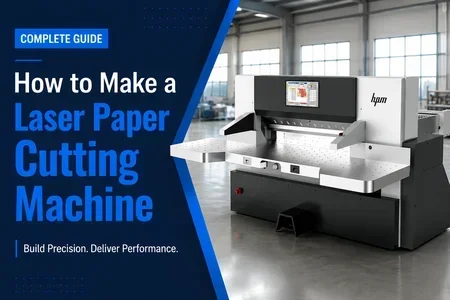
For industrial buyers, the phrase “how to make a laser paper cutting machine” goes beyond DIY assembly. It represents the entire process of sourcing or building a reliable, high-precision cutting system for production environments. Unlike hobbyist machines, industrial units must deliver consistent accuracy, handle high throughput, and comply with safety standards. Procurement teams must evaluate not just the machine itself but the supplier’s engineering capability, component sourcing, and after-sales support. Understanding this distinction reduces the risk of purchasing a machine that fails to meet production demands.
Industrial laser paper cutting machines are used in sectors such as packaging, stationery, and custom paper products. The ability to produce clean, intricate cuts at high speed is critical. When exploring how to make a laser paper cutting machine, buyers must consider the interplay between laser power, motion precision, and control software. A well-designed system can cut paper from lightweight tissue to thick cardboard with minimal kerf and edge charring. The decision to build or buy a machine hinges on internal expertise, production volume, and quality requirements.
Moreover, the phrase “how to make a laser paper cutting machine” also encompasses the integration of safety features like enclosures, fume extraction, and emergency stops. These are non-negotiable in any industrial setting. By understanding the full scope of what it means to make such a machine, procurement professionals can better assess supplier proposals and avoid costly oversights.
How to Make a Laser Paper Cutting Machine: Key Components
Understanding the main subsystems helps you ask better questions during supplier evaluations. A typical laser paper cutting machine includes:
- Laser resonator: The core cutting source; CO₂ lasers are common for non-metal materials like paper. Consider tube lifespan, power stability, and replacement cost.
- Beam delivery optics: Mirrors and lenses that focus the beam; quality affects cut edge and kerf width. Regularly inspect for contamination.
- Motion stage: XY table or gantry system with servo motors and linear encoders for precise positioning. Accuracy of ±0.1 mm or better is standard for industrial paper cutting.
- Fume extractor: Removes airborne particles and odors; important for workplace safety and air quality compliance.
- Control unit: CNC controller with user interface; should offer pattern editing, nesting optimization, and compatibility with CAD software.
Each component must be matched to your application. For instance, a high-resolution encoder is critical for intricate paper cutouts, while a robust fume extractor is essential for continuous production. When evaluating how to make a laser paper cutting machine, prioritize components from reputable brands to ensure reliability and service availability.
How to Evaluate Suppliers When Learning How to Make a Laser Paper Cutting Machine
When assessing suppliers, focus on these critical factors to ensure the machine will perform reliably in your facility:
- Laser source quality: Verify the type (CO₂, fiber, or diode) and power rating. For paper cutting, CO₂ lasers are common; ask about tube lifespan and replacement cost. Suppliers should provide documentation of laser source certifications.
- Motion system precision: Check the drive mechanism (linear rails, ball screws, belt drive) and positioning accuracy. A high-resolution encoder is essential for intricate cuts. Request test reports showing repeatability.
- Software & control: Ensure the controller supports common file formats (DXF, AI, PDF) and offers nesting optimization to reduce waste. Check if the software includes job queuing and remote monitoring capabilities.
- Safety & compliance: Look for CE, FDA laser class, and local electrical certifications. Request documentation of enclosure interlocks and fume extraction. Verify that the machine meets your facility’s safety requirements.
- Support & training: Ask about on-site installation, operator training, and spare parts availability. A weak support network can lead to costly downtime. Inquire about response times and remote diagnostic options.
Use these criteria as a baseline when comparing quotations. Additionally, request references from similar industries. A supplier that specializes in how to make a laser paper cutting machine systems will have deeper application knowledge.
Step 1: Define Your Production Requirements
Before contacting suppliers, document your material types (paper weight, size), maximum thickness, required cutting speed, and batch sizes. This clarity prevents overspecification or underspecification. For example, a packaging company cutting corrugated cardboard will need different laser power than a stationery maker cutting thin art paper. Include future scaling needs.
Step 2: Request Technical Dossiers
Ask each supplier for detailed specs, including laser power curve, maintenance schedule, and power consumption. Cross-check the numbers against your production needs. Request sample cuts on your exact paper grade to evaluate edge quality and speed. This step is crucial when learning how to make a laser paper cutting machine that meets your specific requirements.
How to Prepare an RFQ for a Laser Paper Cutting Machine
A well-structured RFQ saves time and ensures comparable bids. Follow these phases:
Phase 1: Scope of Supply
Specify exactly what you need: machine model, laser power, working area, included software, safety guards, and any optional peripherals like rotary attachments or automatic feeders. Include requirements for documentation, training, and warranty. Be explicit about fume extraction and any environmental controls.
Phase 2: Commercial Terms
Request pricing breakdown (FOB, CIF, installation, training), payment terms, warranty duration, and lead time. Also ask about spare parts pricing and availability. Consider total cost of ownership over five years, including consumables, maintenance, and potential downtime. Compare not only upfront price but also operational efficiency.
In addition, include technical qualification questions in the RFQ to filter suppliers. Ask about their experience with how to make a laser paper cutting machine for your specific industry. Require case studies or references. This step reduces the risk of engaging with unqualified vendors.
Common Procurement Mistakes and How to Avoid Them
- Ignoring total cost of ownership: Low purchase price may hide high consumable costs (laser tubes, lenses) and frequent repairs. Request five-year cost projections including power, maintenance, and spare parts. Factor in operator training time.
- Skipping on-site validation: Video demonstrations can be staged. Visit the supplier’s facility or arrange a test run with your own material before finalizing the order. If distance is an issue, request a remote live test with documented measurements.
- Overlooking software compatibility: Ensure the machine’s controller integrates with your existing design software (e.g., CorelDRAW, Adobe Illustrator) without requiring expensive converters. Test file import/export during the evaluation phase.
- Neglecting after-sales support: Check response times for technical support and the location of service engineers. A supplier with local representation is preferable. Ask about spare parts stocking levels and lead times for critical components.
- Underestimating installation requirements: Laser machines need adequate floor space, power supply, ventilation, and cooling. Verify these before purchase to avoid costly facility modifications.
Avoiding these mistakes ensures that your investment in how to make a laser paper cutting machine translates into a reliable production asset.
FAQ
What is the typical price range for an industrial laser paper cutting machine?
Prices vary widely based on power, work area, and automation level. Entry-level CO₂ laser cutters start around $15,000, while fully automated production lines can exceed $100,000. Always request a customized quote for your specifications. Consider leasing options for better cash flow.
How long does delivery usually take?
Standard machines often ship within 4–8 weeks after order confirmation. Custom configurations may take 10–16 weeks depending on complexity. Factor this into your project timeline and negotiate milestone payments accordingly.
What maintenance is required on a laser paper cutting machine?
Routine tasks include cleaning lenses and mirrors, checking coolant levels, replacing filters in the fume extractor, and lubricating moving parts. Annual professional servicing is recommended to maintain accuracy. Document maintenance schedules in your RFQ to ensure supplier support.
Can I retrofit an existing machine to meet new production demands?
Retrofitting is possible but often limited. Upgrading laser power or motion control may require significant modifications. It is usually more cost-effective to purchase a new unit that is purpose-built for how to make a laser paper cutting machine for your current and future needs.
Conclusion
Sourcing a laser paper cutting machine requires thorough supplier evaluation and a structured RFQ process. By focusing on component quality, safety certifications, and total cost of ownership, procurement teams can avoid expensive mistakes. Start by defining your production requirements, then use the evaluation criteria and RFQ steps outlined above to compare suppliers. For a proven industrial solution, explore how to make a laser paper cutting machine solutions that balance precision, throughput, and support. Remember, the goal is not just to buy a machine, but to acquire a reliable cutting system that enhances your production capabilities.
Related site pages: how to make a laser paper cutting machine, Home.