
 English
 Français
Jul 18, 2026
Jul 18, 2026
Jul 17, 2026
Jul 14, 2026
Apr 03, 2026
Mike Dooley
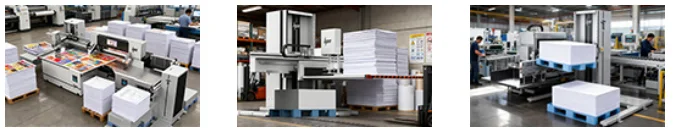
Every production manager remembers that one job: a rush order for 50,000 brochures, tight deadline, and the cutting line jams twice, misaligns three sheets, and needs constant recalibration. According to a 2022 industry survey by Printing United Alliance, finishing operations account for nearly 35% of post-press bottlenecks, with cutting lines being the most frequent culprit.
So how do you choose a paper cutting line that actually solves your throughput problems—without breaking the bank or creating new headaches?
This isn’t about picking the shiniest model. It’s about matching mechanical capabilities to your job mix, operator skill level, and long-term waste reduction goals. Below, we break down seven decision-making dimensions based on real-world feedback from packaging plants and commercial printers.
Many buyers fixate on published accuracy figures (±0.2mm, ±0.1mm, etc.). But what matters more is consistency after thousands of cycles. A line that holds tolerance for the first 2,000 cuts but drifts afterward will cost you in rework.
Look for:
Back gauge repeatability (not just positioning accuracy)
Clamp pressure stability – especially for coated or recycled stocks
Knife angle and material – hardened steel vs. carbide-tipped for abrasive papers
One large folding carton manufacturer reported reducing waste from 4.2% to 1.8% simply by switching to a cutting line with servo-driven back gauge and real-time pressure feedback. That’s the kind of operational gain you want to verify with a demo.
This is where budget meets labor savings. Let’s compare the three common configurations:
| Feature | Semi-Automatic | Automatic (Programmable) | Fully Integrated Line |
|---|---|---|---|
| Loading/Unloading | Manual | Semi-auto lift table | Automatic stacker/unloader |
| Job changeover time | 5–8 min | 2–3 min | <1 min (preset recipes) |
| Operator skill needed | High | Medium | Low (supervisory) |
| Ideal batch size | Any, but cost-effective for <500 | 500–5,000 | >5,000 continuous |
| Typical ROI horizon | 12–18 months | 18–24 months | 24–36 months |
If your typical orders vary widely in size and stock, an automatic programmable line offers the best flexibility. But if you run dedicated long runs (e.g., notebook paper, carton blanks), the fully integrated line’s higher upfront cost pays off through reduced labor and near-zero downtime between jobs.
For a deeper breakdown of how automation levels affect daily output, you can technical specifications comparison.
OSHA 1910.217 (for US) and CE EN 1010 (for Europe) set minimum requirements for cutting machine guarding. But best-in-class lines go beyond two-hand controls and light curtains.
Key safety features to demand:
Brake monitoring system – stops the blade within spec after each cycle
Dual-channel safety relays – prevent single-point failures
Tool-less knife change guard – reduces exposure during maintenance
In 2021, a mid-size printer in Ohio received a $47,000 fine due to an outdated cutting line missing modern light curtain interlocks. Don’t let that be you. Always ask for third-party test certificates (e.g., TÜV, UL) before signing a purchase order.
For shops running more than three job changes per shift, every minute saved on setup adds up. A slow changeover doesn’t just idle the line – it disrupts the entire post-press schedule.
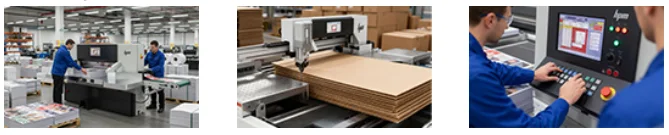
Modern cutting lines offer:
Recipe storage for at least 100 jobs (including knife pressure, clamp timing, back gauge position)
Quick-lock knife clamping – no tools or <1 minute
Auto-adjusting side guides – no manual screws
One European print-on-demand operator shared that moving from a 7-minute changeover to a 90-second changeover allowed them to take on 40% more short-run orders without adding a second shift. That’s the kind of agility that wins contracts.
Few buyers ask about air consumption, yet pneumatic components (clamps, lifts, scrap removal) can account for 20–30% of a cutting line’s operating cost.
Ask the supplier:
Does the line use servo-electric clamps instead of air cylinders? (servo uses 70% less energy)
Is the vacuum table on-demand or continuous?
What’s the standby power draw? (some lines drop to <50W)
Industry benchmarks (based on ISO 50001 data for finishing equipment) show that a properly spec’d servo-driven cutting line consumes roughly 2.8 kWh per 1,000 cuts, compared to 5.1 kWh for a conventional pneumatic model. Over a year of two-shift operation, that difference could pay for a new forklift.
A cutting line is a long-term asset – you’ll live with its serviceability for a decade. Before you commit, physically check (or ask for detailed photos/videos of):
Knife change clearance – can you remove the blade without disassembling the guard?
Oil/grease points – are they reachable without crawling under the line?
Control cabinet layout – labeled terminals, spare fuse slots, clear wiring diagrams
Also request a consumables cost sheet for 12 months: knives, cutting sticks, belts, sensors. Some brands sell the line cheap but mark up proprietary parts by 300%. If you want to avoid hidden costs, consumables and maintenance checklist.
Manufacturers often quote “up to 45 cuts per minute” – but that’s with ideal stock, no misfeeds, and an experienced operator. Ask for practical throughput based on your typical substrate (e.g., 350gsm board, recycled paper with dust).
A reliable way to validate is requesting a run-off test using your own paper samples. Bring your worst stock – the one that tends to curl or have static. The right cutting line will handle it without jams or misalignments.
Here’s a simple scoring method used by packaging consultants:
List your top 3 pain points (e.g., changeover time, waste %, safety compliance)
Weight each (total 100%)
Score candidate lines on each criterion (1–10)
Multiply weight × score and sum
For most commercial printers, the top-weighted factors end up being changeover speed and cutting consistency – not the initial sticker price. The cheapest line often becomes the most expensive after two years of lost production.
If you want to see how these criteria apply to a specific setup – say, running 400,000 A4 sheets per shift – get custom selection advice.
Ignoring floor space: Some cutting lines need rear access of 1.5m for maintenance. Measure twice.
Forgetting training time: A complex CNC interface might require a week of operator training. Factor that into your launch plan.
Overlooking scrap handling: Does the line have a built-in conveyor or chute for waste? Otherwise you’ll pay someone to manually clear it every 15 minutes.
Choosing a paper cutting line isn’t about finding a “best” machine – it’s about finding the right match for your job mix, operator skills, and long-term waste reduction goals. The seven factors above (accuracy consistency, automation level, safety, changeover speed, energy use, maintenance access, and real throughput) give you a vendor-neutral framework.
If you prefer a partner who provides transparent performance data, modular upgrade options, and documented third-party test results, you can explore the approach taken by HPM. Their cutting line solutions are designed with servo-driven accuracy, quick changeover tooling, and a clear consumables cost plan. explore HPM’s modular design.
Still unsure which specification fits your daily orders? A 30-minute conversation with an application engineer – using your actual job tickets – can remove the guesswork.
GET A QUOTE