
 English
 Français
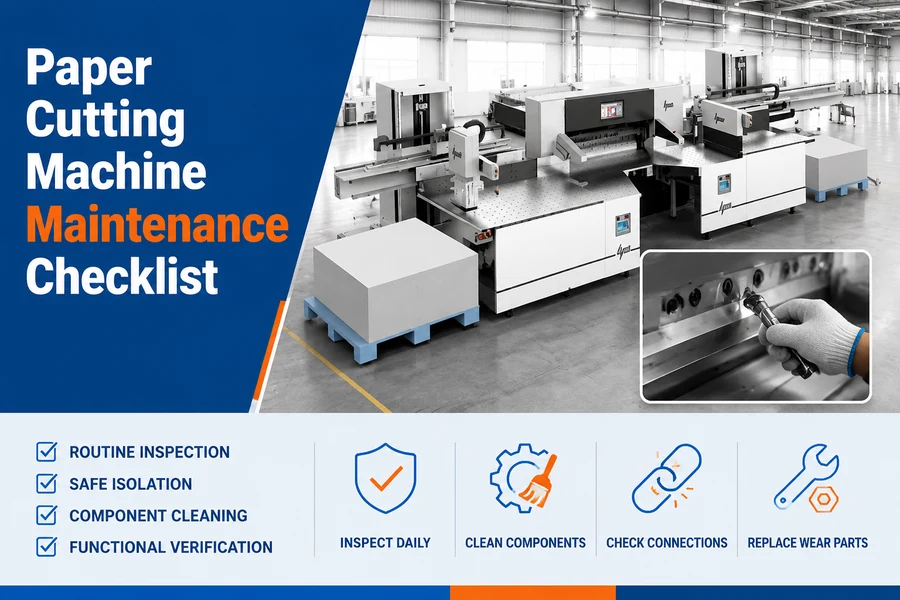
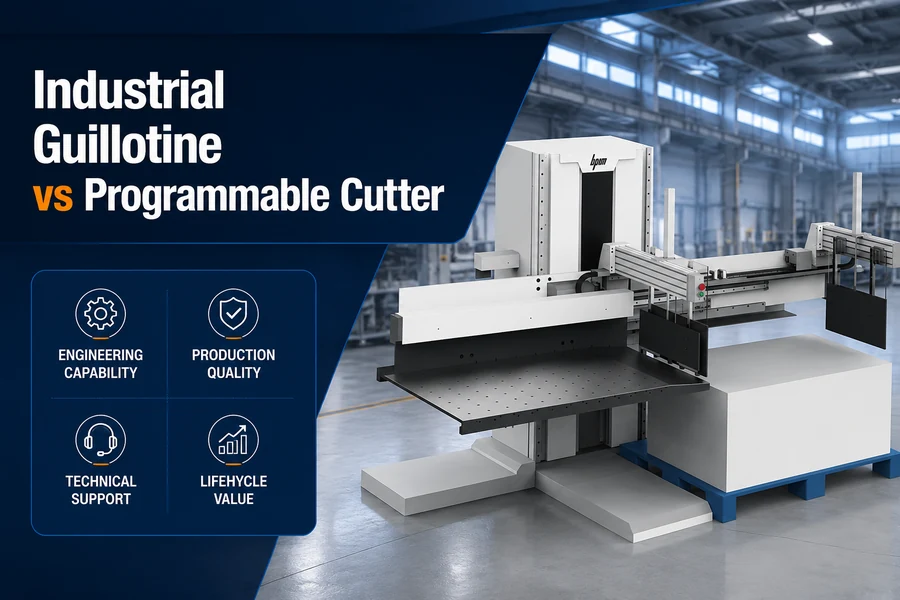

Article Overview: This article provides a maintenance checklist for paper cutting machines, covering lubrication frequency, blade wear symptoms, and cutting pressure adjustment. Written for engineering managers and technical buyers, it helps reduce downtime and extend machine life through practical, evidence-based guidance.

How often should I lubricate a paper cutting machine?
Lubricate a paper cutting machine every 40–50 operating hours or per manufacturer guidelines, focusing on the backgauge leadscrew, knife guide, and clamp slide rails. Regular lubrication prevents wear and maintains cut accuracy.
Proper lubrication reduces friction on critical moving parts, directly affecting positioning precision and machine longevity. As a typical guideline, the backgauge leadscrew requires light machine oil (ISO 32–68) applied to the threaded shaft, followed by full travel to distribute the oil evenly. The knife guide rail should be wiped clean and then coated with a thin film of way oil or lithium grease daily. Clamp slide rails benefit from weekly lithium grease application. Pneumatic components need monthly lubrication with pneumatic tool oil (ISO 10–22) added to the lubricator reservoir.
Neglecting lubrication can lead to increased force requirements, premature wear of bushings and bearings, and inconsistent cut quality. Always consult the machine’s service manual for exact lubricant grades and intervals. Using the wrong lubricant may cause seal swelling or reduced clamping force.
| Component | Frequency | Lubricant type | Method |
|---|---|---|---|
| Backgauge leadscrew | Every 40–50 hours | Light machine oil (ISO 32–68) | Apply oil to threaded shaft, move backgauge full travel |
| Knife guide rail | Daily | Way oil or lithium grease | Wipe rail, apply thin film, cycle knife manually |
| Clamp slide rails | Weekly | Lithium grease | Apply grease to rails, operate clamp several times |
| Pneumatic components | Monthly | Pneumatic tool oil (ISO 10–22) | Add to lubricator reservoir per manual |
Document each lubrication event in a machine log with date, component, and lubricant used. This record helps identify trends and schedule preventive maintenance.
What are common signs of blade wear on a guillotine?
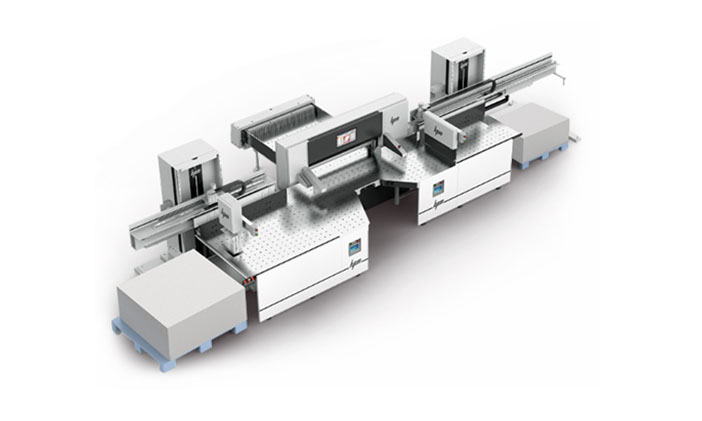
Common signs of blade wear include torn or fuzzy cut edges, increased cutting force required, unusual noise during the cut, and a visible dull or chipped edge. Prompt inspection prevents damage to the cutting stick and machine.
Symptom-to-cause diagnosis helps identify the root issue before costly repairs. Torn or fuzzy edges indicate a blunt blade or nicks on the cutting edge; inspect with a magnifying glass for chipping. Increased cutting force, felt by the operator or seen on a hydraulic gauge, suggests blade dullness or incorrectly adjusted clamping pressure. Unusual grinding or snapping noises often signal blade contact with the cutting stick or misalignment; stop the machine immediately and check the gap between blade and stick. A visible dull edge—shiny and rounded compared to a sharp bevel—confirms the need for resharpening. Typical edge angles are 22–25 degrees for paper cutting.
Keeping a log of blade changes and inspection results helps predict sharpening intervals. For high-volume operations, consider a blade life tracking system.
How to adjust cutting pressure on a paper cutter?
For hydraulic cutters, adjust pressure via the relief valve; for mechanical cutters, adjust the clamp spring tension. Always refer to the manual and verify with a pressure gauge to avoid paper slip or overstressing the knife.
Step 1: Identify the system type
Check if the clamp is hydraulic (common on programmable guillotines) or mechanical (spring-loaded). Hydraulic systems have a pressure gauge and relief valve; mechanical systems use adjustable nuts on clamp springs.
Step 2: Locate the adjustment point
Hydraulic: find the pressure relief valve near the hydraulic block. Mechanical: locate the spring tension nuts on the clamp arms, often accessible under the front table.
Step 3: Set the pressure
Hydraulic: turn the relief valve screw clockwise to increase pressure, counterclockwise to decrease. Use a pressure gauge; typical clamping pressure for paper is 1.5–3.0 MPa (220–435 psi) depending on stack height and material. Mechanical: turn the spring nuts equally; measure force using a clamp force indicator if available.
Step 4: Perform a test cut
Run a test on a clean stack. Check for paper slip (indicates low pressure) or indent marks on the top sheet (indicates high pressure). Readjust if needed.
Step 5: Verify repeatability
Make three identical cuts and measure variation. Pressure fluctuations over time may indicate hydraulic system issues (air in fluid, worn seals) or mechanical binding.
Escalation conditions: If pressure cannot be adjusted within the specified range, or if you observe erratic pressure readings, contact HPM maintenance service and support for paper cutters for preventive maintenance.
Routine maintenance checklist for paper cutting machines
A systematic daily, weekly, and monthly checklist extends machine service life and prevents unexpected downtime. Key items include cleaning, lubrication, blade inspection, and safety device testing.
Daily tasks should include cleaning the table and backgauge surfaces to remove dust and debris, checking oil levels in the hydraulic reservoir, and lubricating the knife guide rail. Test two-hand safety controls to ensure each button releases within 0.5 seconds. Weekly, lubricate clamp slide rails with grease and inspect the blade edge for chips or dullness using a magnifier. Monthly, check cutting stick wear—rotate or replace if grooved more than 1 mm—and verify backgauge accuracy by cutting test squares and measuring with a caliper. Quarterly, test hydraulic system pressure against manufacturer specs. Annually, replace hydraulic filters and air dryer elements per manual or after 2000 hours of operation.
| Frequency | Task | Notes |
|---|---|---|
| Daily | Clean table and backgauge surfaces | Remove dust and debris; inspect for nicks |
| Daily | Check oil levels in hydraulic reservoir | Maintain between min/max marks |
| Daily | Knife guide lubrication | Wipe and reapply light oil |
| Daily | Test two-hand safety controls | Ensure each button releases within 0.5 seconds |
| Weekly | Lubricate clamp slide rails | Apply grease; check for smooth movement |
| Weekly | Inspect blade edge for chips or dullness | Use a magnifier; document condition |
| Monthly | Check cutting stick wear | Rotate or replace if grooved more than 1 mm |
| Monthly | Verify backgauge accuracy | Cut test squares and measure with caliper |
| Quarterly | Test hydraulic system pressure | Compare to manufacturer spec |
| Annual | Replace hydraulic filters and air dryer elements | Per manual or after 2000 hours |
Service-life practices: Keep a maintenance log with dates and observations. Train operators to report anomalies early. Schedule professional service if the machine exceeds 10 years or 50,000 cuts without major overhaul.
FAQ
How often should I replace the cutting stick?
Replace the cutting stick when you see grooves deeper than 1 mm or when cut quality degrades. Typically every 10,000–30,000 cuts depending on material hardness. Rotate the stick regularly to extend life.
What type of oil should I use for backgauge leadscrew?
Use a light machine oil with ISO viscosity grade 32–68. Avoid heavy grease as it can attract dust and impede movement. Check your manual for the exact specification.
Can I sharpen the blade in-house?
In-house sharpening is possible with a dedicated sharpening fixture, but it requires skill to maintain the correct angle and flatness. Many shops prefer professional sharpening to ensure consistency and avoid blade damage.
When should I call for professional maintenance?
Call for professional service if you encounter persistent alignment issues, hydraulic pressure fluctuations, electrical faults, or if the machine has not been serviced in over a year. Timely intervention prevents costly repairs.
How do I know if the clamp pressure is too high?
Signs of excessive clamp pressure include indent marks on the top sheet of the stack, paper wrinkling, or increased force to lower the clamp. Check the pressure gauge and reduce setting if needed.
Conclusion: Prioritize preventive maintenance for long-term reliability
Regular lubrication, blade inspection, and pressure adjustment are the pillars of paper cutting machine maintenance. By adhering to a structured checklist, you reduce unplanned downtime, improve cut quality, and extend machine service life. For expert support, consult your machine’s service manual or a qualified technician.